Hanzo and Genji Banner Art Hanzo and Genji Art
 Written text from the primeval illustrated handscroll (12th century) | |
| Author | Murasaki Shikibu |
|---|---|
| Original title | Genji Monogatari ( 源氏物語 ) |
| Translator | Suematsu Kenchō, Arthur Waley, Edward Chiliad. Seidensticker, Helen McCullough, Royall Tyler, Dennis Washburn |
| Country | Japan |
| Language | Early Eye Japanese |
| Genre | Monogatari |
| Published | Before 1021 |
| Media type | manuscript |
| Dewey Decimal | 895.63 M93 |
The Tale of Genji ( 源氏物語 , Genji monogatari , pronounced [ɡeɲdʑi monoɡaꜜtaɾi]) is a classic work of Japanese literature written in the early 11th century by the noblewoman and lady-in-waiting Murasaki Shikibu. The original manuscript, created effectually the peak of the Heian menstruum, no longer exists. It was made in "concertina" or orihon mode:[one] several sheets of paper pasted together and folded alternately in one direction and so the other.
The work is a unique delineation of the lifestyles of loftier courtiers during the Heian catamenia. Information technology is written in archaic language and a poetic and circuitous style that make it unreadable to the boilerplate Japanese speaker without specialized study.[2] Information technology was non until the early 20th century that Genji was translated into modern Japanese by the poet Akiko Yosano. The first English translation was attempted in 1882 by Suematsu Kencho, simply was of poor quality and incomplete.
The work recounts the life of Hikaru Genji, or "Shining Genji", who is the son of an ancient Japanese emperor (known to readers as Emperor Kiritsubo) and a low-ranking concubine called Kiritsubo Consort. For political reasons, the emperor removes Genji from the line of succession, demoting him to a commoner by giving him the surname Minamoto, and he pursues a career as an imperial officer. The tale concentrates on Genji'southward romantic life and describes the customs of the aloof society of the time. It may be the world's outset novel,[three] the offset psychological novel, and the offset novel still to be considered a classic particularly in the context of Japanese literature.
Historical context [edit]
Murasaki was writing at the height of the Fujiwara association's power—Fujiwara no Michinaga was the Regent in all merely proper noun, and the nearly pregnant political figure of his mean solar day. Consequently, Murasaki is believed to have partially informed the character of Genji through her experience of Michinaga.
The Tale of Genji may have been written chapter by chapter in installments, as Murasaki delivered the tale to aloof women (ladies-in-waiting). It has many elements found in a modernistic novel: a primal character and a very large number of major and minor characters, well-developed characterization of all the major players, a sequence of events covering the central character's lifetime and beyond. There is no specified plot, just events happen and characters simply grow older. Despite a dramatis personæ of some four hundred characters, it maintains internal consistency; for instance, all characters age in step, and both family and feudal relationships stay intact throughout.
One complexity for readers and translators of the Genji is that near none of the characters in the original text are given an explicit name. The characters are instead referred to by their function or office (e.g. Minister of the Left), an honorific (e.g. His Excellency), or their relation to other characters (e.thousand. Heir Apparent), which changes as the novel progresses. This lack of names stems from Heian-era courtroom manners that would take made it unacceptably familiar and blunt to freely mention a person'south given name. Mod readers and translators have used various nicknames to keep rail of the many characters.
[edit]

At that place is contend over how much of Genji was actually written by Murasaki Shikibu. Debates over the novel's authorship have gone on for centuries, and are unlikely to ever be settled unless some major archival discovery is fabricated.
It is by and large accepted that the tale was finished in its present form by 1021, when the author of the Sarashina Nikki wrote a diary entry near her joy at acquiring a complete copy of the tale. She writes that at that place are over 50 chapters and mentions a character introduced at the finish of the work, so if other authors too Murasaki did work on the tale, the piece of work was finished very nearly to the fourth dimension of her writing. Murasaki's own diary includes a reference to the tale, and indeed the awarding to herself of the name 'Murasaki' in an innuendo to the main female person character. That entry confirms that some if not all of the diary was bachelor in 1008 when internal show convincingly suggests that the entry was written.[4]
Murasaki is said to have written the character of Genji based on the Minister on the Left at the time she was at court. Other translators, such every bit Tyler, believe the grapheme Murasaki no Ue, whom Genji marries, is based on Murasaki Shikibu herself.
Yosano Akiko, the first author to make a modern Japanese translation of Genji, believed that Murasaki had only written chapters 1 to 33, and that chapters 35 to 54 were written by her daughter, Daini no Sanmi.[5] Other scholars take also doubted the authorship of chapters 42 to 54 (particularly 44, which contains rare examples of continuity mistakes).[5] According to Royall Tyler's introduction to his English translation of the piece of work, recent[ when? ] computer analysis has turned up "statistically significant" discrepancies of style between chapters 45–54 and the rest, and also amidst the early on capacity.[5]
Plot [edit]

Affiliate xv – Yomogiu ( 蓬生 , "Waste of Weeds"). Scene from the 12th-century illustrated handscroll Genji Monogatari Emaki kept at the Tokugawa Art Museum.

Chapter sixteen – Sekiya ( 関屋 , "At The Pass")

Chapter 37 – Yokobue ( 横笛 , "Flute").
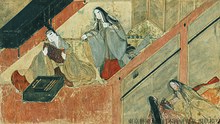
Chapter 39 – Yūgiri ( 夕霧 , "Evening Mist"). twelfth-century Gotoh Museum handscroll.

Affiliate 48 – Sawarabi ( 早蕨 , "Bracken Shoots"). Tokugawa Art Museum'due south illustrated handscroll.
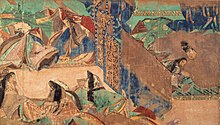
Chapter 49 – Yadorigi ( 宿り木 , "Ivy"). Tokugawa Art Museum's illustrated handscroll.
Genji's female parent dies when he is three years old, and the Emperor cannot forget her. The Emperor Kiritsubo and so hears of a woman (Lady Fujitsubo), formerly a princess of the preceding emperor, who resembles his deceased concubine, and later she becomes one of his wives. Genji loves her first as a stepmother, merely subsequently equally a adult female, and they autumn in love with each other. Genji is frustrated by his forbidden love for the Lady Fujitsubo and is on bad terms with his own wife (Aoi no Ue, the Lady Aoi). He engages in a series of honey affairs with other women. These are however unfulfilling, equally in almost cases his advances are rebuffed, or his lover dies of a sudden, or he becomes bored.
Genji visits Kitayama, a rural hilly area north of Kyoto, where he finds a beautiful ten-yr-former girl. He is fascinated by this little girl (Murasaki), and discovers that she is a niece of the Lady Fujitsubo. Finally he kidnaps her, brings her to his own palace and educates her to be similar the Lady Fujitsubo, who is his womanly ideal. During this time Genji also meets Lady Fujitsubo secretly, and she bears his son, Reizei. Everyone except the ii lovers believes the father of the child is the Emperor Kiritsubo. Later the male child becomes the Crown Prince and Lady Fujitsubo becomes the Empress, but Genji and Lady Fujitsubo swear to keep the child's truthful parentage undercover.
Genji and his wife, Lady Aoi, reconcile. She gives nascency to a son but dies soon later. Genji is sorrowful but finds consolation in Murasaki, whom he marries. Genji's begetter, the Emperor Kiritsubo, dies. He is succeeded by his son Suzaku, whose mother (Kokiden), together with Kiritsubo's political enemies, take power in the court. And then another of Genji'southward secret love affairs is exposed: Genji and a concubine of the Emperor Suzaku are discovered while meeting in secret. The Emperor Suzaku confides his personal entertainment at Genji's exploits with the adult female (Oborozukiyo), merely is duty-bound to punish Genji even though he is his half-brother. He exiles Genji to the town of Suma in rural Harima Province (now part of Kobe in Hyōgo Prefecture). There, a prosperous human being known every bit the Akashi Novice (because he is from Akashi in Settsu Province) entertains Genji, and Genji has an affair with Akashi's daughter. She gives birth to Genji's only daughter, who will later become the Empress.
In the capital the Emperor Suzaku is troubled by dreams of his late father, Kiritsubo, and something begins to affect his eyes. Meanwhile, his mother, Kokiden, grows ill, which weakens her influence over the throne, and leads to the Emperor ordering Genji to be pardoned. Genji returns to Kyoto. His son by Lady Fujitsubo, Reizei, becomes the emperor. The new Emperor Reizei knows Genji is his real male parent, and raises Genji's rank to the highest possible.
Even so, when Genji turns 40 years old, his life begins to decline. His political status does not change, but his love and emotional life begin to incrementally diminish as center age takes hold. He marries another wife, the Third Princess (known as Onna san no miya in the Seidensticker version, or Nyōsan in Waley's). Genji'south nephew, Kashiwagi, later forces himself on the 3rd Princess, and she bears Kaoru (who, in a similar situation to that of Reizei, is legally known as the son of Genji). Genji's new spousal relationship changes his relationship with Murasaki, who had expressed her wish of becoming a nun ( bikuni ) though the wish was rejected past Genji.
Genji's beloved Murasaki dies. In the following chapter, Maboroshi ("Illusion"), Genji contemplates how fleeting life is. Immediately after the chapter titled Maboroshi , in that location is a chapter titled Kumogakure ("Vanished into the Clouds"), which is left blank, but implies the decease of Genji.
Chapter 45–54 are known as the "Uji Chapters". These capacity follow Kaoru and his all-time friend, Niou. Niou is an imperial prince, the son of Genji's daughter, the electric current Empress now that Reizei has abdicated the throne, while Kaoru is known to the world as Genji's son only is in fact fathered by Genji's nephew. The chapters involve Kaoru and Niou's rivalry over several daughters of an imperial prince who lives in Uji, a place some altitude away from the capital. The tale ends abruptly, with Kaoru wondering if Niou is hiding Kaoru's quondam lover abroad from him. Kaoru has sometimes been called the get-go anti-hero in literature.[6]
Completion [edit]
The tale has an abrupt ending. Opinions vary on whether this was intended by the writer. Arthur Waley, who made the first English language translation of the whole of The Tale of Genji, believed that the work as we have it was finished. Ivan Morris, all the same, author of The World of the Shining Prince, believed that it was not complete and that subsequently capacity were missing. Edward Seidensticker, who fabricated the second translation of the Genji, believed that Murasaki Shikibu had not had a planned story construction with an ending as such simply would simply have continued writing as long equally she could.
Literary context [edit]
Because it was written to entertain the Japanese court of the 11th century, the work presents many difficulties to modern readers. First and foremost, Murasaki's linguistic communication, Heian-period court Japanese, was highly inflected and had very complex grammar. Another problem is that naming people was considered rude in Heian courtroom order, so none of the characters are named within the work; instead, the narrator refers to men often by their rank or their station in life, and to women oft by the color of their wearable, or past the words used at a meeting, or past the rank of a prominent male person relative. This results in different appellations for the aforementioned character depending on the chapter.
Some other aspect of the language is the importance of using poetry in conversations. Modifying or rephrasing a classic poem according to the current situation was expected behavior in Heian courtroom life, and often served to communicate thinly veiled allusions. The poems in the Genji are often in the archetype Japanese tanka class. Many of the poems were well known to the intended audience, and so usually only the beginning few lines are given and the reader is supposed to complete the thought themselves, leaving the residue – which the reader would exist expected to know – unspoken.
As with most Heian literature, Genji was probably written mostly (or peradventure entirely) in kana (Japanese phonetic script) and not in kanji, considering it was written past a woman for a female audition. Writing in kanji was at the time a masculine pursuit; women were mostly discreet when using kanji, confining themselves generally to native Japanese words ( yamato kotoba ).
Outside of vocabulary related to politics and Buddhism, Genji contains remarkably few Chinese loan words ( kango ). This has the effect of giving the story a very even, smooth flow. Even so, it too introduces confusion: at that place are a number of homophones (words with the same pronunciation merely different meanings), and for modernistic readers, context is non always sufficient to determine which significant was intended.
Structure [edit]
Outline [edit]
The novel is traditionally divided into three parts, the first two dealing with the life of Genji and the last with the early years of ii of Genji'due south prominent descendants, Niou and Kaoru. There are likewise several short transitional chapters which are usually grouped separately and whose authorships are sometimes questioned.
- Genji's rise and fall
- Youth, chapters 1–33: Love, romance, and exile
- Success and setbacks, chapters 34–41: A taste of power and the death of his beloved wife
- The transition (chapters 42–44): Very brusk episodes following Genji's decease
- Uji, chapters 45–54: Genji'south official and secret descendants, Niou and Kaoru
The 54th and last chapter, "The Floating Bridge of Dreams", is sometimes argued past modern scholars to be a split part from the Uji function. It seems to continue the story from the previous chapters simply has an unusually abstract chapter championship. It is the but affiliate whose title has no clear reference within the text, although this may be due to the chapter beingness unfinished. This question is made more than difficult past the fact that we exercise not know exactly when the chapters acquired their titles.
List of capacity [edit]
The English translations hither are taken from the Arthur Waley, the Edward Seidensticker, the Royall Tyler, and the Dennis Washburn translations. It is not known for certain when the chapters acquired their titles. Early mentions of the Tale refer to chapter numbers, or incorporate alternate titles for some of the chapters. This may suggest that the titles were added later. The titles are largely derived from poetry that is quoted within the text, or allusions to various characters.

Affiliate five – Wakamurasaki ( 若紫 , "Young Murasaki"). Tosa Mitsuoki, 1617–91.

Chapter 20 – Asagao ( 朝顔 , "The Bluebell"). Tosa Mitsuoki.

Chapter 42 – Niō no Miya ( 匂宮 , "The Perfumed Prince"). Tosa Mitsuoki.
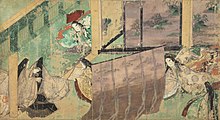
Chapter 50 – Azumaya ( 東屋 , "Eastern Cottage"). 12th-century Tokugawa Art Museum handscroll.
| Chapter | Japanese | Waley | Seidensticker | Tyler | Washburn |
|---|---|---|---|---|---|
| 01 | Kiritsubo ( 桐壺 ) | "Kiritsubo" | "The Paulownia Court" | "The Paulownia Pavilion" | "The Lady of the Paulownia-Courtyard Chambers" |
| 02 | Hahakigi ( 帚木 ) | "The Broom-Tree" | "Broom Cypress" | ||
| 03 | Utsusemi ( 空蝉 ) | "Utsusemi" | "The Beat of the Locust" | "The Cicada Beat out" | "A Molted Cicada Beat" |
| 04 | Yūgao ( 夕顔 ) | "Yugao" | "Evening Faces" | "The Twilight Beauty" | "The Lady of the Evening Faces" |
| 05 | Wakamurasaki ( 若紫 ) | "Murasaki" | "Lavender" | "Immature Murasaki" | "Piffling Majestic Gromwell" |
| 06 | Suetsumuhana ( 末摘花 ) | "The Saffron-Flower" | "The Safflower" | ||
| 07 | Momiji no Ga ( 紅葉賀 ) | "The Festival of Red Leaves" | "An Autumn Excursion" | "Beneath the Autumn Leaves" | "An Imperial Celebration of Fall Foliages" |
| 08 | Hana no En ( 花宴 ) | "The Flower Banquet" | "The Festival of the Scarlet Blossoms" | "Under the Cherry Blossoms" | "A Banquet Celebrating Cherry Blossoms" |
| 09 | Aoi ( 葵 ) | "Aoi" | "Heartvine" | "Heart-to-Eye" | "Leaves of Wild Ginger" |
| x | Sakaki ( 榊 ) | "The Sacred Tree" | "The Green Branch" | "A Co-operative of Sacred Evergreens" | |
| eleven | Hana Chiru Sato ( 花散里 ) | "The Village of Falling Flowers" | "The Orangish Blossoms" | "Falling Flowers" | "The Lady at the Villa of Handful Orange Blossoms" |
| 12 | Suma ( 須磨 ) | "Exile at Suma" | "Suma" | "Exile to Suma" | |
| xiii | Akashi ( 明石 ) | "Akashi" | "The Lady at Akashi" | ||
| xiv | Miotsukushi ( 澪標 ) | "The Flood Guess" | "Channel Buoys" | "The Pilgrimage to Sumiyoshi" | "Aqueduct Markers" |
| xv | Yomogiu ( 蓬生 ) | "The Palace in the Tangled Wood" | "The Wormwood Patch" | "A Waste of Weeds" | "A Ruined Villa of Tangled Gardens" |
| 16 | Sekiya ( 関屋 ) | "A Meeting at the Frontier" | "The Gatehouse" | "At the Pass" | "The Barrier Gate" |
| 17 | E Awase ( 絵合 ) | "The Picture Competition" | "A Motion picture Contest" | "The Picture Contest" | "A Contest of Illustrations" |
| xviii | Matsukaze ( 松風 ) | "The Wind in the Pine-Trees" | "The Wind in the Pines" | "Wind in the Pines" | |
| 19 | Usugumo ( 薄雲 ) | "A Wreath of Deject" | "A Rack of Clouds" | "Wisps of Cloud" | "A Thin Veil of Clouds" |
| twenty | Asagao ( 朝顔 ) | "Asagao" | "The Morning Celebrity" | "The Bluebell" | "Bellflowers" |
| 21 | Otome ( 乙女 ) | "The Maiden" | "The Maidens" | "Maidens of the Dance" | |
| 22 | Tamakazura ( 玉鬘 ) | "Tamakatsura" | "The Jewelled Chaplet" | "The Tendril Wreath" | "A Lovely Garland" |
| 23 | Hatsune ( 初音 ) | "The Showtime Song of the Yr" | "The First Warbler" | "The Warbler's First Song" | "First Vocal of Spring" |
| 24 | Kochō ( 胡蝶 ) | "The Collywobbles" | "Butterflies" | ||
| 25 | Hotaru ( 螢 ) | "The Glow-Worm" | "Fireflies" | "The Fireflies" | "Fireflies" |
| 26 | Tokonatsu ( 常夏 ) | "A Bed of Carnations" | "Wild Carnation" | "The Pinkish" | "Wild Pinks" |
| 27 | Kagaribi ( 篝火 ) | "The Flares" | "Flares" | "The Cressets" | "Cresset Fires" |
| 28 | Nowaki ( 野分 ) | "The Typhoon" | "An Fall Storm" | ||
| 29 | Miyuki ( 行幸 ) | "The Royal Visit" | "The Royal Outing" | "The Imperial Progress" | "An Purple Excursion" |
| 30 | Fujibakama ( 藤袴 ) | "Blueish Trousers" | "Purple Trousers" | "Thoroughwort Flowers" | "Mistflowers" |
| 31 | Makibashira ( 真木柱 ) | "Makibashira" | "The Cypress Colonnade" | "The Handsome Colonnade" | "A Beloved Pillar of Cypress" |
| 32 | Umegae ( 梅枝 ) | "The Spray of Plum-Blossom" | "A Branch of Plum" | "The Plum Tree Co-operative" | "A Branch of Plum" |
| 33 | Fuji no Uraba ( 藤裏葉 ) | "Fuji no Uraba" | "Wisteria Leaves" | "New Wisteria Leaves" | "Shoots of Wisteria Leaves" |
| 34 | Wakana: Jō ( 若菜上 ) | "Wakana, Role I" | "New Herbs, Function I" | "Spring Shoots I" | "Early Spring Genesis: Part one" |
| 35 | Wakana: Ge ( 若菜下 ) | "Wakana, Part Two" | "New Herbs, Part II" | "Bound Shoots II" | "Early Spring Genesis: Role 2" |
| 36 | Kashiwagi ( 柏木 ) | "Kashiwagi" | "The Oak Tree" | ||
| 37 | Yokobue ( 横笛 ) | "The Flute" | "The Transverse Flute" | ||
| 38 | Suzumushi ( 鈴虫 ) | (omitted) | "The Bell Cricket" | "Bell Crickets" | |
| 39 | Yūgiri ( 夕霧 ) | "Yugiri" | "Evening Mist" | ||
| twoscore | Minori ( 御法 ) | "The Law" | "Rites" | "The Law" | "Rites of Sacred Law" |
| 41 | Maboroshi ( 幻 ) | "Mirage" | "The Wizard" | "The Seer" | "Spirit Summoner" |
| 10 | Kumogakure ( 雲隠 ) | "Vanished into the Clouds" | |||
| 42 | Niō Miya ( 匂宮 ) | "Niou" | "His Perfumed Highness" | "The Perfumed Prince" | "The Fragrant Prince" |
| 43 | Kōbai ( 紅梅 ) | "Kobai" | "The Rose Plum" | "Red Plum Blossoms" | "Red Plum" |
| 44 | Takekawa ( 竹河 ) | "Bamboo River" | |||
| 45 | Hashihime ( 橋姫 ) | "The Bridge Maiden" | "The Lady at the Bridge" | "The Maiden of the Bridge" | "The Divine Princess at Uji Bridge" |
| 46 | Shii ga Moto ( 椎本 ) | "At the Foot of the Oak-Tree" | "Below the Oak" | "At the Foot of the Oak Tree" | |
| 47 | Agemaki ( 総角 ) | "Agemaki" | "Trefoil Knots" | "A Bowknot Tied in Maiden'southward Loops" | |
| 48 | Sawarabi ( 早蕨 ) | "Fern-Shoots" | "Early Ferns" | "Bracken Shoots" | "Early Fiddlehead Greens" |
| 49 | Yadorigi ( 宿木 ) | "The Mistletoe" | "The Ivy" | "Trees Encoiled in Vines of Ivy" | |
| 50 | Azumaya ( 東屋 ) | "The Eastern Firm" | "The Eastern Cottage" | "A Hut in the Eastern Provinces" | |
| 51 | Ukifune ( 浮舟 ) | "Ukifune" | "A Boat upon the Waters" | "A Globe-trotting Boat" | "A Boat Bandage Adrift" |
| 52 | Kagerō ( 蜻蛉 ) | "The Gossamer-Wing" | "The Drake Fly" | "The Mayfly" | "Ephemerids" |
| 53 | Tenarai ( 手習 ) | "Writing-Practice" | "The Writing Practice" | "Writing Exercise" | "Practising Calligraphy" |
| 54 | Yume no Ukihashi ( 夢浮橋 ) | "The Bridge of Dreams" | "The Floating Span of Dreams" | "A Floating Bridge in a Dream" | |
The additional chapter between 41 and 42 in some manuscripts is called Kumogakure ( 雲隠 ) which means "Vanished into the Clouds"—the chapter is a title only, and is probably intended to evoke Genji'south expiry. Some scholars accept posited the earlier being of a chapter between ane and 2 which would have introduced some characters that seem to announced very abruptly in the book as it stands.
The Waley translation completely omits the 38th chapter.
Later on authors have composed additional chapters, nearly frequently either betwixt 41 and 42, or afterwards the end.
Manuscripts [edit]
The original manuscript written by Murasaki Shikibu no longer exists. Numerous copies, totaling around 300 according to Ikeda Kikan, exist with differences between each. It is idea that Shikibu often went dorsum and edited early manuscripts introducing discrepancies with earlier copies.[vii]
The various manuscripts are classified into 3 categories:[8] [9]
- Kawachibon ( 河内本 )
- Aobyōshibon ( 青表紙本 )
- Beppon ( 別本 )
In the 13th century, 2 major attempts by Minamoto no Chikayuki and Fujiwara Teika were made to edit and revise the differing manuscripts. The Chikayuki manuscript is known as the Kawachibon ; edits were many start in 1236 and completing in 1255. The Teika manuscript is known as the Aobyōshibon ; its edits are more than conservative and thought to better represent the original. These two manuscripts were used as the basis for many future copies.
The Beppon category represents all other manuscripts not belonging to either Kawachibon or Aobyōshibon . This includes older but incomplete manuscripts, mixed manuscripts derived from both Kawachibon and Aobyōshibon , and commentaries.
On March 10, 2008, it was announced that a late Kamakura period (1192–1333) manuscript had been constitute in Kyoto,[10] [11] containing the 6th chapter, Suetsumuhana ; the manuscript was 65 pages in length. Almost remaining manuscripts are based on copies of the Teika manuscript which introduced revisions in the original; this manuscript, however, belongs to a dissimilar lineage and was not influenced by Teika. Professor Yamamoto Tokurō, who examined the manuscript, said, "This is a precious discovery as Kamakura manuscripts are so rare." Professor Katō Yōsuke said, "This is an important discovery equally it asserts that non-Teika manuscripts were beingness read during the Kamakura period."
On Oct 29, 2008, Konan Women's University appear that a mid-Kamakura period manuscript had been found,[12] [13] [14] containing the 32nd chapter, Umegae . The manuscript was recognized as the oldest extant copy of this chapter, dating to between 1240 and 1280. The manuscript, considered to be of the Beppon category, is 74 pages in length and differs from Aobyōshi manuscripts in at least 4 places, raising the "possibility that the contents may be closer to the undiscovered Murasaki Shikibu original manuscript".[12]
On Oct 9, 2019, information technology was appear that an original re-create of Teika's Aobyōshibon had been constitute in Tokyo at the abode of the current head of the Okochi-Matsudaira clan, who ran the Yoshida Domain. The manuscript is the fifth affiliate, Wakamurasaki ( 若紫 ), and is the oldest version of the affiliate. Blue ink common in Teika'south manuscript and handwriting assay confirmed that the manuscript was written by Teika, making it among the five original versions of the Aobyōshibon known to exist.[xv]
Illustrated scrolls [edit]

Tardily-16th- or early-17th-century hanging roll in ink and gold leaf illustrating a scene from Genji.
Numerous illustrations of scenes from Genji take been produced, almost notably a twelfth-century ringlet, the Genji Monogatari Emaki , containing illustrated scenes from Genji together with handwritten sōgana text. This whorl is the earliest extant instance of a Japanese "picture scroll": nerveless illustrations and calligraphy of a unmarried piece of work. The original scroll is believed to take comprised 10–xx rolls and covered all 54 capacity. The extant pieces include but 19 illustrations and 65 pages of text, plus 9 pages of fragments. This is estimated at 15% of the envisioned original.
The Tokugawa Art Museum in Nagoya has three of the scrolls handed down in the Owari co-operative of the Tokugawa clan and one roll held by the Hachisuka family unit is now in the Gotoh Museum in Tokyo. The scrolls are designated National Treasures of Nihon. The scrolls are then fragile that they normally are not shown in public. The original scrolls in the Tokugawa Museum were shown from November 21 to November 29 in 2009. Since 2001, they have been displayed in the Tokugawa Museum annually for effectually one week in November. An oversize English photoreproduction and translation was published in limited edition in 1971 past Kodansha International.[sixteen]
Other notable illustrated scrolls of Genji are by Tosa Mitsuoki, who lived from 1617 to 1691. His paintings are closely based on Heian style from the existing scrolls from the 12th century and are fully complete. The tale was likewise a popular theme in ukiyo-eastward prints from the Edo period.
Modern readership [edit]
Japanese [edit]

Pages from the illustrated handscroll from the 12th century
The Tale of Genji was written in an archaic court linguistic communication, and a century after its completion it was unreadable without specialized study. Annotated and illustrated versions existed as early as the 12th century.[17] Information technology was not until the early 20th century that Genji was translated into modern Japanese, by the poet Akiko Yosano.[xviii] Therefore, translations into modern Japanese and other languages solve these problems by modernizing the linguistic communication, unfortunately losing some of the meaning, and by giving names to the characters, usually the traditional names used by academics. This gives rising to anachronisms; for example, Genji's first married woman is named Aoi because she is known as the lady of the Aoi chapter, in which she dies.
Both scholars and writers have tried translating information technology. The starting time translation into modern Japanese was made by the poet Yosano Akiko. Other known translations were done by the novelists Jun'ichirō Tanizaki and Fumiko Enchi.
Because of the cultural differences, reading an annotated version of the Genji is quite common, even amongst Japanese readers. There are several annotated versions past novelists, including Seiko Tanabe, Jakucho Setouchi and Osamu Hashimoto.[19] Many works, including a manga series and unlike television dramas, are derived from The Tale of Genji. There have been at to the lowest degree five manga adaptations of Genji.[20] A manga version was created by Waki Yamato, Asakiyumemishi (The Tale of Genji in English), and a electric current version by Sugimura Yoshimitsu[21] [ better source needed ] is in progress. Another manga, Genji Monogatari , by Miyako Maki, won the Shogakukan Manga Award in 1989.[22]
English translations [edit]
The kickoff fractional translation of Genji into English was by Suematsu Kenchō, published in 1882. Arthur Waley published a six-volume translation of all merely one chapter, with the outset volume published in 1925 and the last in 1933.[23] In 1976, Edward Seidensticker published the start complete translation into English language, made using a self-consciously "stricter" approach with regards to content if non grade.[24] The English language translation published in 2001 by Royall Tyler aims at allegiance in content and grade to the original text.[v] The most recently written ("Genji and the Luck of the Sea") dates from 2007. Its initial version has been extensively revised, retitled, and updated for this publication.[25]
Every bit of 2008[update], WorldCat identifies 88 editions of Genji. The major translations into English are each slightly unlike, mirroring the personal choices of the translator and the menstruum in which the translation was made. Each version has its claim, its detractors and its advocates, and each is distinguished by the name of the translator. For case, the version translated by Arthur Waley would typically exist referred to every bit "the Waley Genji".
Major English translations [edit]
In chronological order:
- The Suematsu Genji (1882) – Suematsu's Genji was the first translation into English, merely is considered of poor quality and is not oftentimes read today. Significantly, only a few capacity were completed.
- The Waley Genji (1925–1933) – Waley'due south Genji is considered a corking achievement for his time,[26] although some purists have criticized Waley'south changes to the original.[27] Others have criticized every bit overly-complimentary the manner in which Waley translated the original text. Regardless, it continues to exist well-appreciated and widely read today.[28] When the Waley Genji was beginning published, it was eagerly received. For instance, Time explained that "the reviewers' floundering tributes indicate something of its variegated entreatment. In limpid prose The Tale combines curiously modern social satire with great charm of narrative. Translator Waley has done service to literature in salvaging to the Occident this masterpiece of the Orient."[29]
- The Seidensticker Genji (1976) – Seidensticker's Genji is an attempt to right what were perceived to have been Waley's failings without necessarily making his translation obsolete. Seidensticker hews more closely to the original text, but in the interests of readability, he takes some liberties. For example, he identifies most of the characters by name and then that the narrative can be more than easily followed by a broad-based audition of Western readers. (In 2008, a 4,400-page Braille version of the Seidensticker Genji was completed. This Braille edition was the production of v Japanese housewives from Setagaya, Tokyo, working voluntarily for 5 years and was later donated to the Japan Braille Library ( 日本点字図書館 ) and the Library of Congress. It is also available for download.)[30]
- The McCullough Genji (1994) – An abridgement.
- The Tyler Genji (2001) – Tyler's Genji contains more extensive explanatory footnotes and commentary than the previous translations, describing the numerous poetical allusions and cultural aspects of the tale. Tyler consciously attempted to mimic the original style in means that the previous translations did not. For example, this version does not utilize names for most characters, identifying them instead by their titles in a manner which was conventional in the context of the 11th-century original text. Writing for the New York Times, reviewer Janice Nimura described it as "wonderfully evocative of the original, [but] tin can be difficult to follow".[31] Tyler's version "makes a special virtue of attending to a certain ceremonial indirectness in the way the characters address one another. The bang-up temptation for a translator is to say the implied things, and Tyler never gives in to it."[ attribution needed ] [32] This has been praised by some critics[ who? ] every bit "preserving more of what one time seemed unfamiliar or strange to English readers",[ attribution needed ] as understanding the culture of Murasaki's fourth dimension is arguably a master reason for reading Genji.[28]
- The Washburn Genji (2015) – Dennis Washburn'due south Genji separates the poems from the prose and puts interior thoughts in italics. The translation has been received slightly more controversially than Tyler's, with well-nigh criticism aimed at the perceived over-clarification of the text and add-on of modern colloquialisms.[33]
Reception and legacy [edit]
The Tale of Genji is an important work of Japanese literature, and modern authors have cited it as inspiration, such as Jorge Luis Borges who said of it, "The Tale of Genji, as translated by Arthur Waley, is written with an almost miraculous naturalness, and what interests us is not the exoticism—the horrible word—but rather the human being passions of the novel. Such involvement is just: Murasaki's work is what ane would quite precisely call a psychological novel ... I dare to recommend this book to those who read me. The English translation that has inspired this brief insufficient note is called The Tale of Genji."[34] Information technology is noted for its internal consistency, psychological delineation, and characterization. The novelist Yasunari Kawabata said in his Nobel Prize credence voice communication: "The Tale of Genji in particular is the highest pinnacle of Japanese literature. Fifty-fifty down to our day there has not been a piece of fiction to compare with it."

2000 yen note with The Tale of Genji and Murasaki Shikibu on the right corner
The Genji is also often referred to as "the outset novel",[35] though there is considerable debate over this; other texts that predate Genji, such as the 7th-century Sanskrit Kādambari , are considered to be novels, and there is contend around whether Genji can fifty-fifty be considered a "novel". Some[ who? ] consider the psychological insight, complication and unity of the piece of work to authorize information technology for "novel" status while simultaneously disqualifying before works of prose fiction.[36] Others[ who? ] encounter these arguments every bit subjective and unconvincing.
Related claims, perhaps in an attempt to sidestep these debates, are that Genji is the "first psychological novel" or "historical novel",[37] "the first novel however considered to exist a archetype" or other more qualified terms. However, critics have almost consistently described The Tale of Genji as the oldest, first, and/or greatest novel in Japanese literature,[38] [39] though enthusiastic proponents may have later neglected the qualifying category of 'in Japanese literature', leading to the debates over the book's identify in world literature. Even in Japan, the Tale of Genji is not universally embraced; the lesser-known Ochikubo Monogatari has been proposed equally the "world'due south starting time full-length novel", fifty-fifty though its author is unknown.[40] Despite these debates, The Tale of Genji enjoys solid respect amongst the works of literature, and its influence on Japanese literature has been compared to that of Philip Sidney's Arcadia on English literature.[38]
The novel and other works by Lady Murasaki are staple reading cloth in the curricula of Japanese schools. The Bank of Nihon issued the 2000 yen banknote in her laurels, featuring a scene from the novel based on the twelfth-century illustrated handscroll. Since a one Nov 1008 entry in The Diary of Lady Murasaki is the oldest appointment on which a reference to The Tale of Genji has appeared, Nov 1 was designated as the official day to celebrate Japanese classics. According to Act on Classics Day, the "classics" that are honored not merely include literature, simply encompass a wide range of arts such as music, fine art, traditional performing arts, entertainment, lifestyle fine art including tea ceremony and flower organization and other cultural products.[41]
The names of the chapters became a central chemical element a sort of incense based game chosen Genjikō, function of the larger practise of Monkō popular amidst the nobility. In Genjikō, players must match the scents of a series of five incense samples without being told the names of said samples. Each possible combination was matched to a symbol, chosen a genji-mon , that represented a chapter from the story.[42]
Adaptations in other media [edit]
- 12th-century illustrated paw curl, Genji Monogatari Emaki
- 1951 pic The Tale of Genji by Kōzaburō Yoshimura
- 1966 movie past Kon Ichikawa
- 1980 manga Asaki Yume Mishi past Waki Yamato
- 1981 theatre operation run by the Takarazuka Revue
- 1987 anime picture show The Tale of Genji by Gisaburō Sugii – covers simply the first 12 chapters, while adding in some psychological motivation that is not explicit in the novel.
- 1987 moving-picture show O Desejado
- 1989 theatre functioning run by the Takarazuka Revue
- 1988 manga by Miyako Maki
- 2000 opera past Miki Minoru
- 2001 moving-picture show Sennen no Koi Story of Genji
- 2009 anime serial Genji Monogatari Sennenki by Osamu Dezaki
- 2011 film Genji Monogatari: Sennen no Nazo
- 2015 theatre performance run by the Takarazuka Revue; actress Asumi Rio received the Agency for Cultural Diplomacy Arts Festival award for her portrayal of Genji.
See also [edit]
- The Tale of Genji Museum
- Jūnihitoe , the layered, colour-coded robes worn by female members of the Imperial court
- Sudare
- Ghost stories
- Hagiwara Hiromichi
- Yang Guifei
- You Xian Ku
Notes [edit]
- ^ Lyons, Martyn (2011). Books: A Living History. Los Angeles: J. Paul Getty Museum. p. 30.
- ^ Birmingham Museum of Art (2010). Guide to the Collection. Birmingham, AL. p. 49. ISBN978-1-904832-77-5.
- ^ Lyons, Martyn (2011), Books: A Living History, London: Thames & Hudson, p. 31
- ^ The Diary of Lady Murasaki, ed. Richard Bowring, Penguin Classics 2005, p. 31, notation 41. In his introduction to the text, Bowring discusses its dating which, in any case, is generally accustomed by about authorities. Royall Tyler, in his edition of the Tale of Genji cited below, as well draws attending to the entry in Murasaki Shikibu's diary: see the Penguin Books edition, 2003, Introduction, p. xvii
- ^ a b c d Shikibu, Murasaki; Tyler, Royall (2002). The Tale of Genji. Viking.
- ^ Seidensticker (1976: xi)
- ^ Yamagishi (1958: 14)
- ^ Yamagishi (1958: 14–16)
- ^ Nihon Koten Bungaku Daijiten (1986: 621–22)
- ^ "鎌倉後期の源氏物語写本見つかる" (in Japanese). Sankei News. 2008-03-x. Archived from the original on 2008-03-xiv. Retrieved 2008-03-11 .
- ^ "源氏物語の「別本」、京都・島原の「角屋」で発見" (in Japanese). Yomiuri. 2008-03-10. Archived from the original on 2008-03-xiv. Retrieved 2008-03-11 .
- ^ a b "源氏物語の最古級写本、勝海舟?の蔵書印も…甲南女子大" (in Japanese). Yomiuri. 2008-10-29. Archived from the original on 2008-11-01. Retrieved 2008-10-29 .
- ^ "「千年紀に奇跡」「勝海舟が恋物語とは」源氏物語写本に驚きの声" (in Japanese). Sankei News. 2008-10-29. Archived from the original on Baronial ii, 2009. Retrieved 2008-ten-29 .
- ^ "源氏物語:最古の「梅枝巻」写本 勝海舟の蔵書印も". Mainichi (in Japanese). 2008-10-29. Retrieved 2008-x-29 . [ dead link ]
- ^ "Fifth chapter of oldest 'Tale of Genji' copy found in Tokyo:The Asahi Shimbun". The Asahi Shimbun . Retrieved 2019-10-09 .
- ^ Tale of Genji Roll, ISBN 0-87011-131-0)
- ^ ""The Tale of Genji" – Playboy of the eastern earth". The Economist . Retrieved January ix, 2014.
- ^ Yosano, Akiko; NDL.
- ^ Walker, James. Large in Japan: "Jakucho Setouchi: Nun re-writes The Tale of Genji", Archived Apr 26, 2009, at the Wayback Machine Urban center. No. 324; Spaeth, Anthony. "Old-Fashioned lover", Fourth dimension. Dec 17, 2001.
- ^ Richard Gunde (2004-04-27). "Genji in Graphic Detail: Manga Versions of the Tale of Genji". UCLA Asia Found. Retrieved 2006-eleven-16 .
- ^ "源氏物語 25(知泉源氏:プロトタイプ)第十一帖・花散里(全) / July 30th, 2020".
- ^ 小学館漫画賞:歴代受賞者 (in Japanese). Shogakukan. Archived from the original on 2007-09-29. Retrieved 2007-08-19 .
- ^ Titterton, L (4 June 1933). "'The Tale of Genji' Comes to an End". New York Times Volume Review. The New York Times Co. p. seven.
- ^ Shikibu, Murasaki; Seidensticker, Edward (1976). The Tale of Genji . Knopf.
- ^ Tyler, Royall (2009). The Disaster of the 3rd Princess: Essays on the tale of Genji. National Library of Commonwealth of australia.
- ^ "Genji Finished", Fourth dimension. July 3, 1933.
- ^ Takatsuka, Masanori. (1970). Cursory remarks on some mistranslations in Arthur Waley's Tale of Genji
- ^ a b "Coming to Terms with the Alien". [ permanent dead link ] Monumenta Nipponica 58:2
- ^ "In All Nobility," Time. August 27, 1928.
- ^ "Braille version of The Tale of Genji completed in 1,000th year 2008". Yomiuri Shimbun (in Japanese). Archived from the original on 2008-08-25. Retrieved 2009-01-05 .
- ^ Nimura, Janice P (2 Dec 2001). "Courtly Lust". The New York Times . Retrieved three October 2018.
- ^ Wood, Michael. "A Distant Mirror", Fourth dimension. March eleven, 2002.
- ^ Ian Buruma, "The Sensualist," New Yorker, July xx, 2015, p. 67.
- ^ Shikubu, Murasaki; Shikibu, Murasaki (2010-03-10). The Tale of Genji (Tuttle Classics). p. Editorial Reviews. ISBN978-4805310816.
- ^ Tyler, Royall (2003). The Tale of Genji. Penguin Classics. pp. i–ii & xii. ISBN0-14-243714-X.
- ^ Ivan Morris, The World of the Shining Prince (1964), p. 277
- ^ Tyler, Royall (2003). The Tale of Genji. Penguin Classics. p. xxvi. ISBN0-14-243714-Ten.
- ^ a b Bryan (1930), 65.
- ^ Kokusai Bunka Shinkokai (1970), 37.
- ^ Kato (1979), pp. 160, 163.
- ^ "Symposium Commemorating Classics Day". MEXT. Retrieved vi July 2018.
- ^ Japan Encyclopedia, p. 237, at Google Books
Bibliography [edit]
- Allen, James Sloan (2008). "How Cute, How Lamentable," in Worldly Wisdom: Great Books and the Meanings of Life . Savannah: Frederic C. Beil.
- Bargen, Doris G (June 1988). "Spirit Possession in the Context of Dramatic Expressions of Gender Conflict: The Aoi Episode of the Genji monogatari". Harvard Periodical of Asiatic Studies. 48 (1): 95–130. doi:x.2307/2719274. JSTOR 2719274.
- Bargen, Doris G (June 1991). "The Search for Things By in the Genji monogatari". Harvard Journal of Asiatic Studies. 51 (1): 199–232. doi:10.2307/2719245. JSTOR 2719245.
- Bargen, Doris G (1997). A Woman's Weapon : Spirit possession in the Tale of Genji. Honolulu: University of Hawaiʻi Press.
- Bowring, Richard John (1988). Murasaki shikibu, The Tale of Genji . Cambridge; New York: Cambridge University Printing.
- Bryan, J. Ingram (1930). The Literature of Nihon. New York: Henry Holt and Visitor.
- Childs, Margaret H (1999). "The value of vulnerability: Sexual coercion and the nature of beloved in japanese court of literature". Periodical of Asian Studies. 58 (4): 1059–80. doi:x.2307/2658495. hdl:1808/16325. JSTOR 2658495.
- Chisholm, Julianne Kaui (November 1994). "The Steel-belted Radial of Karma: The End of Genji". The Journal of the Clan of Teachers of Japanese. 28 (2): 183–93. doi:x.2307/489291. JSTOR 489291.
- De Wolf, Charles (2014). "Glimpses of Genji Through the Looking-Glass of Language". The Transactions of the Asiatic Society of Japan. 5th series, volume six.
- D'Etcheverry, Charo B (2007). Love after The Tale of Genji : Rewriting the World of the Shining Prince. Cambridge, MA: Harvard University Press.
- Field, Norma (1987). The Splendor of Longing in the Tale of Genji. Princeton, NJ: Princeton University Press.
- Fri, Karl (Summertime 1988). "Teeth and Claws. Provincial Warriors and the Heian Court". Monumenta Nipponica. 43 (2): 153–85. doi:10.2307/2384742. JSTOR 2384742.
- Gatten, Aileen (Jump 1977). "A Wisp of Smoke. Scent and Character in the Tale of Genji". Monumenta Nipponica. 32 (1): 35–48. doi:x.2307/2384070. JSTOR 2384070.
- Gatten, Aileen (June 1981). "The Order of the Early Chapters in the Genji monogatari". Harvard Periodical of Asiatic Studies. 41 (1): 5–46. doi:ten.2307/2718998. JSTOR 2718998.
- Gatten, Aileen (April 1986). "Weird Ladies: Narrative Strategy in the Genji monogatari". The Journal of the Association of Teachers of Japanese. 21 (1): 29–48. doi:10.2307/489516. JSTOR 489516.
- Goff, Janet Emily (1991). Noh Drama and the Tale of Genji : The Art of Allusion in Fifteen Classical Plays. Princeton, NJ: Princeton University Press.
- Henitiuk, Valerie (2008). "Going to Bed with Waley: How Murasaki Shikibu Does and Does Non Become World Literature". Comparative Literature Studies. 45 (1): 40–61. doi:10.1353/cls.0.0010. JSTOR 25659632.
- Hirota, Akiko (Fall 1997). "The Tale of Genji: From Heian Archetype to Heisei Comic". Journal of Pop Culture. 31 (ii): 29–68. doi:x.1111/j.0022-3840.1997.00029.x.
- Kamens, Edward B (1993). Approaches to Education Murasaki Shikibu's The Tale of Genji. New York: Modern Linguistic communication Clan of America.
- Kato, Shuichi (1979). A History of Japanese Literature: The First Thousand Years. David Chibbett. New York: Kodansha International, Ltd. ISBN0-87011-491-3.
- Knapp, Bettina L (Leap 1992). "Lady Murasaki Shikibu's the Tale of Genji: Search for the Mother". Symposium. 46 (1): 34–48. doi:10.1080/00397709.1992.10733759.
- Kornicki, P. F., "Unsuitable Books for Women? "Genji Monogatari" and "Ise Monogatari" in Belatedly Seventeenth-Century Japan", Monumenta Nipponica, Vol. 60, No. 2 (Summer, 2005), pp. 147–93, Sophia Academy, JSTOR
- Kokusai Bunka Shinkokai, ed. (1970). Introduction to Archetype Japanese Literature. Greenwood Printing. ISBN0-8371-3118-9.
- McCormick, Melissa (2003). "Genji Goes West: The 1510 "Genji Album" and the Visualization of Court and Majuscule". The Art Bulletin. 85 (1): 54–85. doi:10.2307/3177327. JSTOR 3177327.
- McCullough, William H (1967). "Japanese Spousal relationship Institutions in the Heian Flow". Harvard Periodical of Asiatic Studies. 27: 103–67. doi:10.2307/2718385. JSTOR 2718385.
- Morris, Ivan I (1964). The World of the Shining Prince: Court Life in Ancient Japan. New York: Kodansha International.
- Morris, Ivan I (1971). The Tale of Genji Scroll [Genji monogatari emaki]. Tokyo: Kodansha International.
- Mostow, Joshua S (Fall 1992). "Painted Poems, Forgotten Words. Poem-Pictures and Classical Japanese Literature". Monumenta Nipponica. 47 (3): 323–46. doi:10.2307/2385102. JSTOR 2385102.
- Mostow, Joshua S (April 1999). ""Picturing" in The Tale of Genji". The Journal of the Association of Teachers of Japanese. 33 (1): 1–25. doi:10.2307/489628. JSTOR 489628.
- Murase, Miyeko (1983). Iconography of the Tale of Genji : Genji monogatari ekotoba . New York: Weatherhill.
- Murase, Miyeko (2001). The Tale of Genji : Legends and Paintings. New York: One thousand. Braziller.
- Nickerson, Peter (Wintertime 1993). "The Meaning of Matrilocality. Kinship, Holding, and Politics in Mid-Heian". Monumenta Nipponica. 48 (4): 429–67. doi:10.2307/2385292. JSTOR 2385292.
- Japan Koten Bungaku Daijiten: Kan'yakuban [A Comprehensive Dictionary of Classical Japanese Literature: Concise Edition]. Tōkyō: Iwanami Shoten. 1986. ISBN4-00-080067-1.
- Okada, H. Richard (1991). Figures of Resistance : Linguistic communication, Poetry, and Narrating in the Tale of Genji and Other Mid-Heian Texts. Durham: Knuckles University Press.
- Pekarik, Andrew (1982). Ukifune : Dearest in the tale of genji. New York: Columbia University Printing.
- Puette, William J (1983). Guide to the Tale of Genji past Murasaki Shikibu . Rutland, VT: C.E. Tuttle. ISBN9780804814546.
- Rowley, Gillian Gaye (2000). Yosano Akiko and the Tale of Genji. Ann Arbor: Center for Japanese Studies, University of Michigan.
- Seidensticker, Edward Chiliad. (1976). The Tale of Genji. Vol. 1. Tuttle Publishing. ISBN978-4-8053-0919-3.
- Seidensticker, Edward G. (1976). The Tale of Genji. Vol. two. Tuttle Publishing. ISBN978-4-8053-0920-ix.
- Sestili Daniele (1996). Musica eastward danza del principe Genji. Le arti dello spettacolo nell'antico Giappone. Lucca: LIM,
- Shirane, Haruo (December 1985). "The Aesthetics of Power: Politics in the Tale of Genji". Harvard Journal of Asiatic Studies. 45 (2): 615–47. doi:10.2307/2718974. JSTOR 2718974.
- Shirane, Haruo (1987). The Bridge of Dreams : A Poetics of the Tale of Genji. Stanford: Stanford Academy Press.
- Shirane, Haruo (2008). Envisioning the Tale of Genji: Media, Gender, and Cultural Production. New York: Columbia Academy Press.
- Stevenson and Ho, Barbara and Cynthia O (2000). Crossing the Bridge : Comparative Essays on Medieval European and Heian Japanese Women Writers . New York: Palgrave. ISBN9780312221676.
- Tyler, Royall (1999). "'I Am I': Genji and Murasaki". Monumenta Nipponica. 54 (4): 435–80. doi:10.2307/2668318. JSTOR 2668318.
- Tyler, Royall (2001). The Tale of Genji. New York: Viking.
- Tyler, Royall (March 2002). "Wedlock, Rank and Rape in The Tale of Genji". Intersections: Gender, History and Civilization in the Asian Context. 7.
- Tyler, Royall and Susan (2002). "The Possession of Ukifune". Asiatica Venetiana. 5: 177–209.
- Tyler, Royall (2003). "Rivalry, Triumph, Folly, Revenge: A Plot Line through the Tale of Genji". Journal of Japanese Studies. 29 (2): 251–87.
- Ury, Marian (1988). "A Heian Note on the Supernatural". The Journal of the Association of Teachers of Japanese. 22 (2): 189–94. doi:x.2307/488941. JSTOR 488941.
- Lawrence, Hollendaisde (1958). Japan Koten Bungaku Taikei 14: Genji Monogatari ane (in Japanese). Tōkyō: Iwanami Shoten. ISBNfour-00-060014-1.
- Yoda, Tomiko (Dec 1999). "Fractured Dialogues: Mono no aware and Poetic Advice in the Tale of Genji". Harvard Journal of Asiatic Studies. 59 (ii): 523–57. doi:10.2307/2652721. JSTOR 2652721.
External links [edit]
- The Tale of Genji – Oxford Text Archive A complete English translation of the work, gratuitous for non-commercial use, Edward G. Seidensticker'due south translation.
- The Tale of Genji, 1654 Library of Congress, Asian Partitioning. The edition in the Library of Congress is a complete and well-preserved fix including the complete chief text (54 volumes) of Tale of Genji, also Meyasu (3 volumes, commentary on key words and phrases in the text, Keizu (genealogy), Yamaji no tsuyu (a sequel to the work past a subsequently author), and Hikiuta (index).
- Japanese Literature – Including Selections from Genji Monogatari and Classical Poetry and Drama of Nihon Contains the 1882 Suematsu translation of the first 17 chapters of The Tale of Genji, with an introduction and notes.
- The Texts of Genji Monogatari Original text, romanized version, and modern Japanese translation of The Tale of Genji at the University of Virginia Library.
- Tale of the Genji woodcuts Woodcut illustrations and accompanying excerpts at the UNESCO Global Heritage Pavilion.
- The Picture show Scroll of The Tale of Genji Some scans of the Genji Monogatari Emaki (Tale of Genji Ringlet). Only about half of the images are from the 12th-century scroll; they are the darker colored, more faded images.
- The Tale of Genji A photographic guide to The Tale of Genji.
- The Tale of Genji Audiobooks Japanese reading of 7 of 54 capacity from the original text, mp3 files.
- Japan Finance Minister Announces Kyoto Money Design with The Tale of Genji Theme The Kyoto Prefecture commemorative coin gear up for release in Oct 2008 features a scene from The Tale of Genji.
- Carving of Picture Scroll of Genji monogatari Newspaper carvings past Noda Kazuko reproducing the eighteen extant illustrations of the 13th-century Genji monogatari emaki.
- Ohmi Gallery A nice drove of Ukiyo-east and Shin-hanga, including illustrations of The Tale of Genji by such artists as Ebina Masao and Utagawa Kunisada.
- Tale of Genji Curlicue 18th century anonymous artist Bachelor at Dartmouth College, it covers the outset 16 chapters of the tale.
- The Tale of Genji by Miyata Masayuki Paper cuts by renowned creative person Miyata Masayuki.
- Globe Digital Library presentation of 源氏物語 Genji monogatari: Volume I, Kiritsubo. Library of Congress. Primary source moveable blazon book. 1596–1615, first printed edition of the world's first great novel.
-
 Genji Monogatari public domain audiobook at LibriVox
 - Tale of Genji chapter summaries.
- The Tale of Genji at Project Gutenberg
Source: https://en.wikipedia.org/wiki/The_Tale_of_Genji
0 Response to "Hanzo and Genji Banner Art Hanzo and Genji Art"
Post a Comment