Can an Evangelical Be Truely Born Again if They Continue to Hate the Catholic Church
Vanished From the Earth
Every bit an evangelical kid, I was terrified of the rapture—and so was everyone I knew. Years afterwards I left the religion, I wanted to understand the ability information technology held over u.s.a. all.
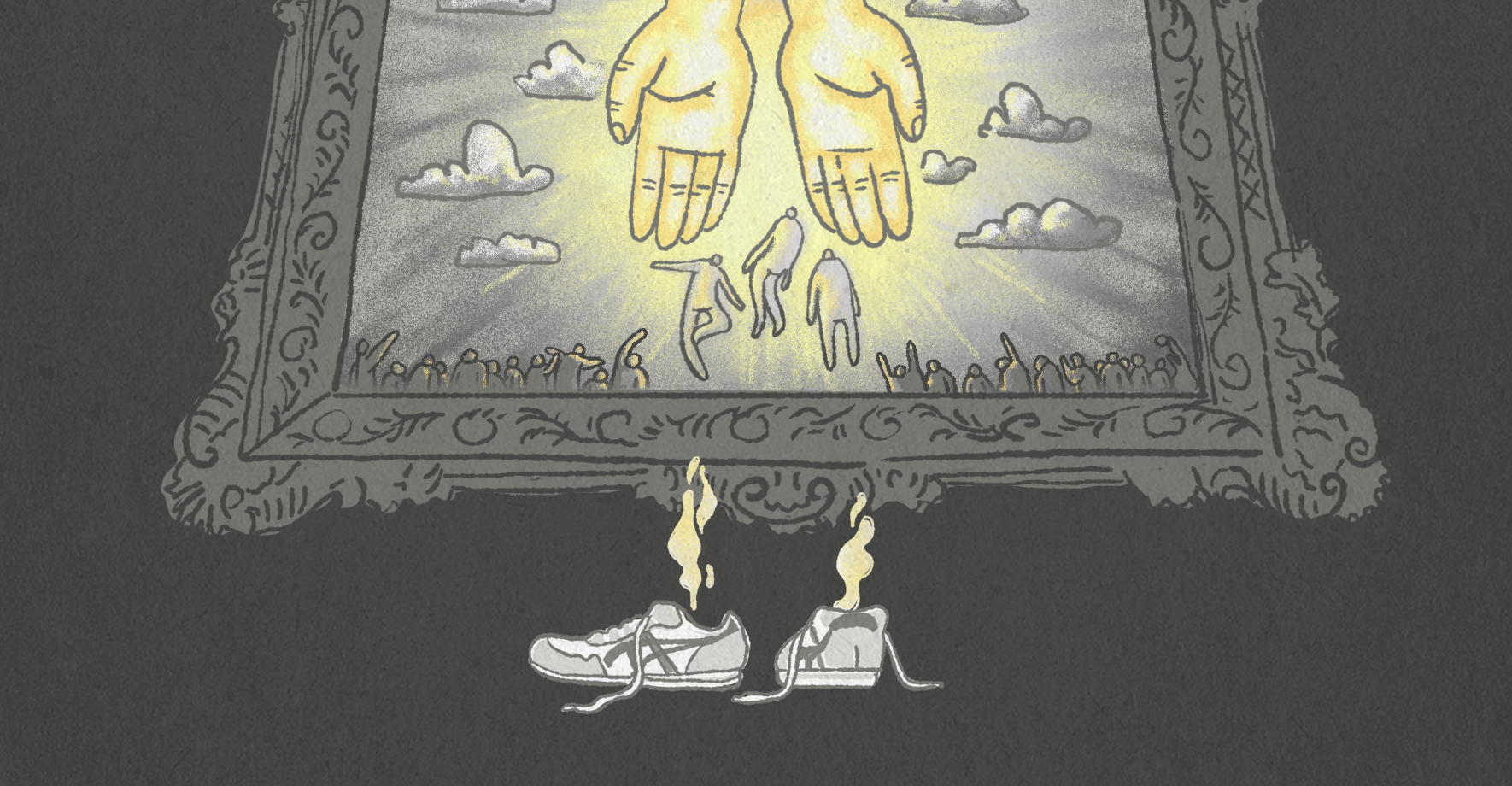
My granddad had a painting, never prominently displayed, of a decrepit graveyard in the dead of night. Its tombstones were musty and unreadable. A crypt loomed in the groundwork. From each burying plot, spirits erupted in shafts of low-cal beaming skyward, while a line from First Corinthians was seen at the bottom: In a moment, in a twinkling of an eye. As a child, I would spot this painting—sometimes perched atop an former armoire, other times leaning against a musty old corner—and stare at it, pulled toward it equally children are drawn to things that frighten them in ways they don't fully understand. This was my introduction to the rapture: as a macabre supernatural dream eluding agreement or explanation, looming on the periphery of my everyday life. A painting that was piece of cake for me to find, but too scary to inquire almost.
Other evangelical kids I knew growing upward would tell me virtually their own kickoff rapture scares. They were always triggered by mundane things: Somebody came back from school one solar day and no one was home. Or someone's parents didn't answer a phone call the mode they normally would have. In an instant, the catholic outlook nosotros'd been instilled with for our entire young lives would coalesce with shocking clarity: Was this information technology? Had the rapture happened? Were we going to confront judgment alone?
It'southward hard to overstate how large the rapture loomed while I was growing up in the evangelical world. As a child, I was taught that I might alive to see the end of the world. I learned how to run across information technology coming, too: How the nation of Israel was "God's timepiece" hitting marks on a prophetic timeline, how the machinations of the Catholic Church and the Un would presently come up to a head and form a i-world government, how God would be driven out of America's public square as people looked to other things for salvation.
This was OK, though, because it meant the finish was near and that the true-blue would have a advantage better than eternal life later on death. They'd skip death entirely, raptured earlier the Globe was allowed to rot in its filth for that era of tribulation before Christ'southward render to dominion all forever, with the faithful by his side. That function is important: The rapture isn't just near terror. It's seduction. Something to feel special about.
In this, the rapture has get a uniquely American fearfulness, and a uniquely American hope. Information technology'southward both a widely known bit of Christian mythology—religious and secular popular civilisation akin accept frequently depicted some manner of supernatural event that would crusade many to of a sudden disappear from the Earth—and a controversial, often-misunderstood topic of theology. It's a fairy tale used to frighten children and a lullaby for grown adults, including my own parents. I'g no longer waiting for the rapture, and yet I see it everywhere.
I was almost 8 years old when I sabbatum in a church that wanted its congregation to know, in clinical detail, what information technology was like to die on a cross. The sanctuary of the Florida megachurch—enormous in my memory, merely perhaps I am just recalling my smallness—dimmed its lights that mean solar day. Instead of a sermon, we were shown a documentary. Experts told the states what the body went through when left to die in such a barbarian manner. It felt like a comic volume; the style our faces were rubbed in the colour and shape of it.
Behold! The cruelty of the iron spikes sinking into this man'southward mankind! The fretfulness firing in the sustained agony borne past their bite! Imagine the labor of his lungs, which threaten to plummet equally his body hangs, supported only by these instruments of unjust affliction! The state of shock the mind endures as a crown of thorns is rammed upon it! Hours upon hours of the death that is life!
At 8 years old, you might wonder, as I did: What did Jesus think of me? Why did he have to endure all of this when he did nothing incorrect? Was it really because of me? I'm so sorry.
For many rapture-believing evangelicals in America, life is bookended by twin traumas. Commencement yous are welcomed with what someone endured on your behalf: Christ on the cross, bearing your sins and mine. The wrongs you take committed and the mistakes you lot have notwithstanding to make, all piled on a back bloodied with lashes long before information technology was nailed to a tree. You are going to mess up, to live a life not worthy of heaven, and therefore Jesus had to die, to right the moral balance and give you the chance to be with him in eternity.
And so y'all must face the trauma that lies at the end of your ain bloodshed. You get asked the question that can haunt you your whole life: Are yous saved? If you are, bang-up. Your walk toward heaven begins. If yous aren't, damnation is always there, waiting to swallow you upwards should you meet an untimely stop or detect yourself excluded from the church's supernatural escape.
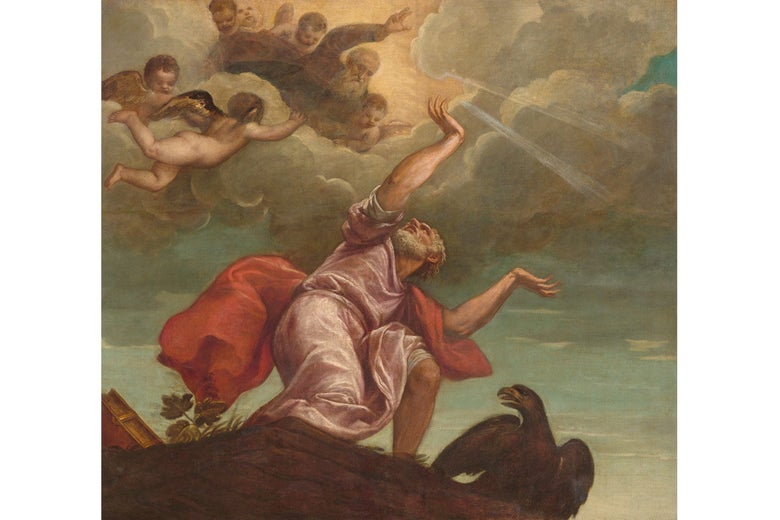
The idea of the rapture emerged from the biblical Volume of Revelation, in which St. John has an elaborate apocalyptic vision that eventually ends with Christ's victory over evil. Thus the rapture warns of a terrible menstruum for humanity in the lead-up to the end of all things, full of suffering, state of war, and natural disaster similar nosotros've never seen before. At its core, the rapture is a promise that yous will not exist here to witness all of that chaos and darkness. Christ volition come dorsum to collect the truthful believers notwithstanding alive on Earth—hence the familiar cultural imagery of slumped piles of clothes and cars abandoned in the street as believers are snatched away in an instant—to unite them in sky with the other believers who have already reached the finish of their natural life. Everyone else gets to find out how bad things can actually get here on Earth, as our species marches to oblivion.
According to a 2018–nineteen survey by the Pew Inquiry Center, 25 percent of U.S. adults place as evangelical. Though data is scarce on exactly what per centum of these Christians believe in the rapture, it's a cadre evangelical conviction preached in countless churches beyond America. (One Pew report from 2011 asserts that vi in 10 evangelical leaders say they believe in the rapture.) In some ways, accepting the rapture feels like the logical decision of the evangelical philosophy: Evangelicalism centers on the born-again conversion experience, the idea that organized religion in Jesus is the sole path to salvation when judgment comes. And the rapture promises that, if this judgment comes earlier your expiry, you'll exist swept abroad and safe.
Since no one actually knows when information technology's supposed to happen, the impending possibility of the rapture is a dandy way to keep kids in line. The only option yous accept is to go set now and alive a Christian life. If you just did that, you'd have nothing to fearfulness.
My father is 51 years old, but he still recalls his earliest impression of church equally a child. How loud the preaching was, the "burn down and brimstone" of it all. "I got really scared," he tells me. He was born in Brooklyn, the son of Puerto Ricans who settled in Manhattan's Spanish Harlem in the '50s and spent much of their life billowy around the metropolis equally career civil servants.
He was 8 years old himself when his family unit converted from a barely adept Catholicism to a strict class of nondenominational fundamentalist Christianity, a genre of faith that adheres to biblical literalism (this is the "fundamentalist" function) and does not marshal itself with whatsoever of the dominant Christian sects (or "denominations") like the Presbyterians, Methodists, or Baptists.
Outside of this formal construction, his father, my granddad, was radicalized by a charismatic preacher in Queens who believed himself to be one of the concluding bastions of truth in a fallen globe. Under his ministry, my grandfather shunned "worldly things"—popular music, telly, movies, strong drink, and potent language. He would stock upward on nonperishables in preparation for the bad times that would come up merely earlier the rapture, when believers would exist persecuted by the secular world, and he gathered almost exclusively with other believers.
One gathering was recorded on cassette record in the jump of 1979, as my grandparents' brothers and sisters in Christ sang songs around a piano for hours. You can hear my male parent, nine years old, running to the tape recorder to whisper his friend's name into it. You lot tin can hear his friend doing the aforementioned and whispering my male parent'southward name back, as their parents fiddled with guitars and tambourines and sang in Spanish with booming voices and gentle harmonies. Y'all can hear my grandmother, her voice thinned by time and shoddy equipment in what must take been a crowded basement. Still, she sounds beautiful. Still, she sounds happy at that place, among the believers, waiting for the end.
"The rapture, at that age? It was painted very bright. It was existent, and it is real," my father tells me at present, recalling the church in Queens my grandfather had brought his family to.
The Florida megachurch where I learned almost the biological shock of crucifixion at age eight had been run by white ministers propping up the ideals of middle-class whiteness, only when I was a teenager, my parents started attending a minor New York City fundamentalist church with other Hispanic believers. It's no small thing, hearing the gospel in the language yous were raised with.
That Hispanic storefront church in New York is where my ideas about faith were formed and fostered. This is where I tried—really tried, harder than for most things I've attempted—to go far work, to be a Christian, to be good. This is where I was told that "trying" really doesn't take anything to do with goodness; faith does. And then I never stopped asking myself if I had whatsoever, and then I left home to go to college in upstate New York and I learned that I did not.
William Miller wasn't the first American to gear up his eyes to the end, but he was the first to give information technology a appointment: sometime between March 21, 1843, and March 21, 1844. His followers, now known as Millerites, numbered somewhere betwixt 50,000 and 100,000, all of them convinced to sell their worldly possessions and attend camp meetings, convinced that Christ would finally return for them to whisk the faithful away to heaven and fulfill his concluding words in the Gospels.
Miller, by some accounts, was a serenity and sincere man who believed his prophecy and faded into obscurity and humiliation when it did not come up to pass a 2d time—later he admitted initial mistake only to claim the real deadline for Christ's return would be six months afterward, on Oct. 22. For half dozen more months, people believed, ready to be snatched abroad simply before judgment's arrival.
Millerites didn't believe in the rapture, per se—Christ's return and the rapture were not always interchangeable ideas for most of Christian history, although they are now—but their apocalypse yearning has come to signify a especially American response to times of social upheaval and great change. Over the next hundred or and so years, what nosotros know today every bit fundamentalist Christianity would brainstorm to accept shape: the hopes and fears of the Millerites reflected and reborn in various Christian sects across the U.s..
Ask most people today nigh the rapture and you'll largely be discussing premillennialism, a religious doctrine devised in function past English language theologian John Nelson Darby in the 1820s and '30s and popularized past American religious leaders like Dwight L. Moody, founder of the Moody Bible Found.
Darby's most lasting idea, and the root of the modernistic rapture, is known as dispensationalism—think of it every bit a sort of geologic timetable, merely for God's dealings with flesh. Darby believed man history could be broken into several eras, or dispensations, during each of which there is a fundamental shift in the relationship between humanity and its maker. The first lasted from Adam until the Great Overflowing, then some other from Noah to Abraham, then Abraham to Moses, then on, each tied to a scriptural turning point.
What'due south important about Darby's piece of work is that it is largely a way for gentiles to insert themselves into a story generally past and about Jewish people, to reorient all scriptures as pertaining to white Protestants (non-Catholic Christians) beyond following the teachings of Christ and the literary richness of the Erstwhile Attestation.
This is where the modern idea of the rapture is born. Having ascribed a scriptural epoch to the Protestant Christians—dubbed the "Church Age"—Darby likewise had to give his age an ending. The result was a dramatic reinterpretation of a passage in 1 Thessalonians, wherein the true believers are vanished from the Earth just before it descends into chaos and God rekindles his human relationship with the Jews willing to accept Christ. A concluding boxing is waged between practiced and evil, and finally, at that place is peace.
The premillennialist view of the scriptures gave Christian leaders an indelible response to a dazzling secular world that was rapidly industrializing: a warning, a secret, a state of war. Jesus is coming, are you fix? The convenience of it all was fiendishly elementary: Yous cannot believe in the rapture and all of its accompanying theology without also embracing some of fundamentalism's core tenets—namely, that the Bible should be taken literally. It's a version of the faith without compromise or adaptation, one that rewards an in-group and shuns all others.
It makes perfect sense that a doctrine of exceptionalism would have root in the state of Manifest Destiny. Just as white Americans saw themselves equally the rightful claimants to the fruits of democracy and the free market, American fundamentalism arranged itself around the belief that the church was exceptional, a torso of believers with a line to God so secure that he would ane twenty-four hour period permit them to cheat death.
When I got to college, it didn't take long for me to feel myself drifting away from faith. I met friends in my dorm who invited me to weekly church building services and to groups similar the Campus Crusade for Christ (now called Cru). I went a few times. Simply as I met other Christian kids from different backgrounds, it struck me that many of them were religious out of joy, that they were doing information technology of their own volition. Meanwhile, I began to feel increasingly similar I'd been raised with a faith of anxiety and shame. Out of all the kids my historic period in our church building community, I was the simply one who went away to schoolhouse.
And then a few months after graduation, I went to a Christian youth camp. The sermons in camps like these—usually somewhere remote, sometimes somewhere common cold—are generally a special kind of fiery. When the congregants are all young and non particularly concerned with the end of their life, the prospect of the rapture is useful for holding them to strict standards of acquit. I was a bit checked out already; I recollect thinking maybe I'd meet a girl there. Only this time, camp was different. The minster didn't speak nearly the rapture, but near the present and the ways faith could exist used by well-pregnant people in ability to hurt others. He said religion could bring hope but it could as well bring trauma, and it was OK to speak of that trauma. This was something I'd been wanting to hear my whole life, something honest, from a minister who wasn't asking me to slow my senses and pray harder. But that kind of thinking wasn't welcome there—the minister was reprimanded and not invited back. Years later, I found out that was the last sermon he e'er preached before walking abroad from Christianity entirely.
Through this lens, I eventually came to believe that Christianity has taken on troubling new shapes in America. That the history taught from pulpits, Christian schools, and politicians has been slowly replaced with hagiography about the religious roots of the American colonies and our destiny as a "Christian nation." That the language of faith has been used to sway the public into supporting the priorities of corporate America.

Then at that place was my growing sense that gimmicky American evangelicalism—that is, equally an institution, a relatively unified strength in culture and politics—largely exists to prop upward white ability structures. The almost loftier-contour and vocal evangelicals, with few exceptions, are white men. Pastors from Franklin Graham to Cary Gordon have worked to brand the evangelical religion synonymous with their domestic agenda: the preservation of white supremacy and minority dominion, the continued privatization of the public sector, the continued marginalization of the LGBTQ community, and victory in the never-catastrophe civilisation wars.
The media is fixated on those white evangelicals too. Compared with the 25 percentage of self-identified evangelicals in America, 16 percent of Americans reportedly place as white evangelicals: a big chunk, but past no means all. Still, it'southward this 16 percent of evangelical Christians who are the implicit field of study of countless op-eds and essays that purport to annotate on evangelicalism writ big—on evangelicals' support of the Capitol anarchism, their resistance to the COVID-19 vaccine, and their role in the ascent of Donald Trump. In the mainstream media, Evangelical Christianity has become a shorthand for whiteness gone incorrect, a peachy scapegoat for a troubling moment in American history that's hard to understand. All of this flattens the wide spread of what Christianity in America really is. And the whiteness of evangelism gets laundered through ideas similar practiced old-fashioned values, patriotism, and bootstraps capitalism.
Evangelicalism is defined in the public imagination by a horde of loud, crusading white men looking to extend their own political and cultural clout. Merely it'south also something else. For some, in fact, the less power y'all have, the more y'all believe, and the more than faith yous cling to; the more poverty you face, the less room you have in your heart, your mind, to trace the structures of ability.
My male parent still goes to the same church I haven't been to in 5 years. He still believes many of the same things. He works for a telecommunications visitor, making certain the servers and circuitry that bring the net to you don't close downwards. He knows his overtime hours will never accrue into meaningful wealth; he knows that despite his best efforts he is ane bad day from losing his home, his auto, his life. He sits in a congregation of Hispanic people who are also aware of this, the filthy cheapness of life.
And so they make a bargain, the only 1 that makes sense, the one that countless others accept made in countless pews: They will stake their claim on the imagined apocalypse of the rapture because, at the very least, that is the doom that will save them in the end. If they're wrong, they get what's coming to them anyway: an unremarkable death in a globe that was hostile to them, their hopes firmly planted on what comes next. And if they're right?
"There's an underlining of joy," my father tells me, "because you lot know he'due south preparing a place where all these elements that affect us and are attacking us here, in this flesh now—he has promised united states that we won't have whatever of that when he comes to become us. Because he's preparing a perfect place." Over time, he says, his feelings about the rapture have evolved: "It's non something to exist feared. It's a reward."
He recites this like it'southward a passage he's committed to memory, because it largely is. I know those words, that language; I've heard information technology countless times from endless pulpits. I also know how my father sounds when he's not reciting things, when he'south interested, passionate, amused, curious. It'due south not like this. So I enquire him virtually a TV show, just so I can hear what his real voice sounds like again before I hang upwards the telephone.
In evangelical culture, the story of how yous come to Christ is called your testimony. It'due south a vital role of the equation, a reminder to yourself of where you came from and what you might sink dorsum to, the beginning of a glorious redemption that ends with heaven as your reward, either in death or in rapture.
My mother thinks that my birth is when she start realized she wanted to notice something more. At that bespeak, she and her father hadn't spoken in at least six years—her parents divorced when she was 7—and she didn't know where he was. Simply he was a grandpa now, and she wanted to tell him. She started by trying to find him, researching now and and then when she could over the course of a couple years. Eventually she establish him in Philadelphia, dying from AIDS. I accept no memory of this, but that's where I met him, now with a little sister in tow. My female parent tells me she got to talk to him some, only non much. He was very sick.
She didn't go to have most of the conversations she wanted to have. Instead she got to have the one she felt obligated to have with a dying man who bankrupt her heart: to tell him that he needed to make things right with God. His condition would quickly deteriorate, and her efforts to find her father were rewarded with the responsibility of deciding when he would be taken off life back up. "I started to feel similar there was a bigger moving picture here," she tells me over the telephone. "I knew there was something more beyond what we would consider to exist the terminate of his life."
When she was my historic period, she began having feet attacks. Then she turned to faith as a salve, hopping from church building to church until she landed in the small fundamentalist congregation she remains in to this day with my father—a funny little irony, since they met equally irreligious teenagers. She tells me what it was similar to hear preachers tell her how everything would cease: "It was almost like stepping into some other world."
I found picayune apply for apocalyptic thinking afterward I left the church. I'g not terribly worried about the world ending, even as the rich square away in their shelters and water enters the futures market and environmental doom and financial ruin pitter-patter ever closer to most of our lives. My globe, my politics, my love—it'due south all shifted to the present.
And still, in the last weeks of 2020, I stopped sleeping at night. Like my mother did when she was my age, I felt a severe panic assail wrack my trunk without alert; every inch of me quaked as I clung to my fiancée in bed side by side to me and begged her to help. When 1 sleepless night turned into many, I started to get angry. I thought I was done being scared. Simply mayhap the trouble was that I hadn't started looking at what scared me closely plenty.
The specter of the rapture is unavoidable in America now. I see it in pastors' fire-and-brimstone sermons admonishing Muslims and the LGBTQ community and urging people to get right with God. I see it in the curricula of Christian schools that all the same maintain the United States has a part to play in the fundamentalist thought of the Stop Times, that state that the country must once again affirm itself every bit a Christian nation, a light to a doomed world. I saw it in the callous inaction on and lack of business concern from evangelical leaders most the COVID-19 pandemic and our now-regular cycles of gun violence and detest crimes. There'due south a reason why the cliché is thoughts and prayers.
Fictions maintained past working-class faith become deployed by upper-class evangelicals to justify their own sense of entitlement. One poesy I heard a lot growing upwards, often used every bit words of encouragement for those experiencing hardship, was Romans 8:28, which says that all things work for the adept of those who believe. But Rafael Cruz was blithe by a like belief when he claimed his son Ted's Senate campaign would fulfill the Bible'south prophecy that "God would anoint Christian 'kings' " and that Ted would personally oversee an " 'end-fourth dimension transfer of wealth' from the wicked to the righteous."
Thus a symbiotic relationship is formed between wealthy and poor: The one-time cloaks its self-interested vision for the future in the language of inclusivity and uplift, and the latter receives that vision equally its ain kind of hope. Politicians prevarication and trade away their constituents' futures for their own present wealth, and the contours of our world continue to be shaped by those with designs to carelessness it materially, if not spiritually. This isn't a secret, all the same it continues to work. It works because people like my begetter are likewise waiting, praying for a rapture, not out of a desire for power, merely for absolution.
This is non the only answer, but it's the one I've found in churches full of immigrants documented and not, in other churches, far from any cities and highways, full of white folks who gather around what they consider to be an old-fashioned gospel, one that volition save your soul. These churches are where people go to sing and shout and sob about the precariousness they feel all around them, the fear of knowing that the side by side bank check will never be plenty, that their health is forfeit considering the bills will non spare them and the corporations will not protect them, because the people who have given them things to be aroused about are also carving them upward as they grow fat and preach detest. Doom is never far from their mind.
This is how an imagined end becomes more existent than the bodily ends awaiting united states of america. Information technology's how well-meaning people with nothing to gain tin can dismiss a plague that has killed more than than one-half a million of us; it's how they can shut out the nearly irreversible climate crisis looming, how the nearer threat of economic collapse tin can simply hold no sway. Things were already bad, and never accept we had a wider selection of apocalypses on offer. Again, they have chosen rapture.
I never had a big confrontation with my parents about my decision to get out evangelicalism behind. I know they know—I lived with them for a stretch afterwards college, and they didn't see me going to church—just I also realize they prefer denial. My dad in item would rather not talk about my faith at all. I can imagine exactly what my mom would say nigh my panic attacks: that the fear I feel is just evidence that I need to come to Jesus equally she did. Every week, she yet texts me the livestream link for church; I never respond. My mom and dad love me hugely, only they don't have the linguistic communication for vulnerability, for uncertainty, for meeting people where they are.
Once upon a time, my parents wanted answers. Now, they know where to observe those answers: with their savior, who may one solar day come to whisk them abroad. Neither of my parents are worried near how it volition all piece of work out. "There's no manner our finite heed can wrap itself around what's infinite," my mother says. She leaves information technology unsaid, merely in her voice I hear her deepest wish: not just that she will someday find herself vindicated for all her behavior, simply that her loved ones—me, my siblings, her father—will all bring together her one day, lost in what's space.
Source: https://slate.com/human-interest/2021/05/rapture-fear-evangelical-americans-church-miller.html
0 Response to "Can an Evangelical Be Truely Born Again if They Continue to Hate the Catholic Church"
Post a Comment